
31 August 2026 · TJ Smile Studio
Trial smile in Glasgow: test speech, bite and lip support same day
See your new veneers before any drilling. TJ Smile Studio in Glasgow offers same day digital trial smiles to test speech, bite and lip support.
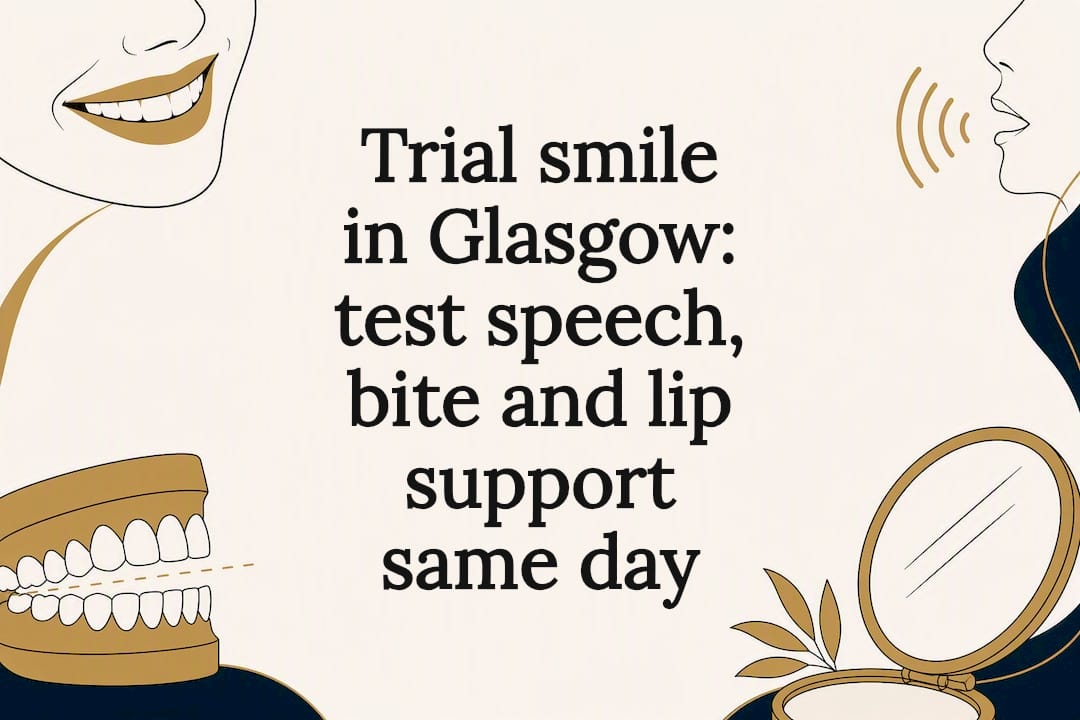
A trial smile is a reversible, in-mouth preview of your planned cosmetic changes, showing you how new tooth shape, length and colour will actually look and feel before any drilling happens. Dentists use it to test speech, bite and lip support in real time, and you can request changes before a single tooth is touched. It carries no permanent commitment.
TL;DR:
- The choice of fabrication method for a trial smile depends on the extent of the redesign, with composite suitable for small tweaks and digital or indirect techniques better for full smiles.
- The trial smile allows real-time speech, bite, and lip support testing, revealing issues like lip support or speech problems that photos alone cannot show.
- A mock-up will never match final porcelain exactly in shade or translucency, so expect slight differences, but it significantly reduces the risk of costly remakes.
- Dentists may decline veneers if gum disease, enamel deficiency, bruxism, or bite issues prevent safe and lasting results, requiring pre-treatment first.
- Preparation for a trial smile involves bringing visual references, asking specific questions about methods and costs, and trusting clinics that facilitate scrutiny and offer transparent planning.
Table of Contents
- What is a trial smile in cosmetic dentistry?
- How are trial smiles made: direct, indirect and digital methods?
- What are the benefits and limitations of a trial smile?
- What happens during a trial smile appointment?
- Who is suitable for a trial smile, and when is it not advised?
- How do you prepare for a trial smile consultation?
- Why the clinic behind your trial smile matters
- What dentists learn from watching patients wear a mock-up
- Ready to trial your new smile in Glasgow?
- Sources
- FAQ
What is a trial smile in cosmetic dentistry?
You will hear it called a mock-up, a provisional smile, or an overlay template, depending on which dentist you ask. All three describe the same idea: a temporary version of your future smile that sits over or is built onto your existing teeth so you can see the result in your own mouth, under your own lighting, talking in your own voice.
Clinicians reach for a trial smile whenever changes are significant enough that guesswork is risky, particularly before veneers or major reshaping of tooth length and proportion. It becomes standard practice, not an optional extra, when the plan alters more than a tooth or two.
What it lets you check goes well beyond appearance:
- Whether your lips sit naturally over the new tooth length
- Whether your bite still closes comfortably
- Whether certain sounds, especially “f”, “v” and “s”, come out clearly
The trial smile bridges digital design and reality, letting you see proportions in the flesh rather than on a screen render.
How are trial smiles made: direct, indirect and digital methods?
Three fabrication routes dominate cosmetic dentistry, and each suits a different budget and timeline.
- Direct composite: the dentist free-hands tooth-coloured resin straight onto your teeth chairside. It is fast and endlessly adjustable in the moment, but the result depends heavily on the operator’s hand skills.
- Indirect wax-up with a silicone key or bis-acryl overlay: a lab technician sculpts the design first, then the dentist transfers it into your mouth using a mould. This gives sharper, more predictable shapes, though it adds lab time and cost. An overlay template is the simplified version of this, snapped into place in a single visit rather than sent away.
- Digital workflow: intra-oral scans feed into design software, and a 3D printer produces a physical template the same day. It is the most accurate route and increasingly the fastest.
Pro Tip: Ask which method your dentist plans to use before you book. Direct composite suits small tweaks; digital or indirect techniques suit full smile redesigns where precision matters more than speed.
What are the benefits and limitations of a trial smile?
The clearest benefit is visual confirmation. You see the actual shape and colour in your mouth rather than trusting a computer rendering, and because the mock-up is reversible, you can request refinements without any cost to your natural teeth.
Functional testing matters just as much as looks. Wearing the mock-up reveals whether:
- Your speech stays clear, particularly on sounds that rely on the front teeth
- Your bite closes without new interference points
- Your lips rest naturally, without looking stretched or unsupported
There are limits worth knowing before you go in. The provisional material never matches final porcelain exactly in shade or translucency, so expect the finished result to look slightly different, usually better, once permanent ceramics go in. A trial appointment also adds time and, in some clinics, a modest fee on top of the main treatment plan.
The trade-off is favourable. A mock-up preview reduces the risk of costly remakes once the ceramist begins final fabrication, because the approved design becomes their master reference rather than a guess.
What happens during a trial smile appointment?
The appointment itself follows a fairly consistent sequence, though the exact order shifts slightly depending on whether you are trialling composite or a printed template.
- Records first. Photographs, digital scans and sometimes a full smile design session happen before you ever see a mock-up in your mouth.
- Fitting the preview. The dentist either builds composite directly onto your teeth or seats a pre-made overlay template.
- Mirror and photo checks. You look at the result under normal light, and the dentist takes photographs from several angles to compare against the plan.
- Functional testing. You speak, smile naturally, and bite together while wearing the mock-up, flagging anything that feels off.
- Adjustment and approval. Small tweaks happen there and then; once you approve the look, that exact design becomes the lab’s working reference for the permanent restorations.
Nothing here is rushed through. If speech feels awkward with the mock-up in place, that same problem will likely show up in the final veneers, so this is the point to raise it.
Who is suitable for a trial smile, and when is it not advised?
Trial smiles suit anyone planning a noticeable aesthetic change, especially if you are unsure exactly how far you want to go with tooth shape or length. If your goals are still a little vague, seeing options in your own mouth tends to sharpen your thinking faster than any consultation photo library.
Dentists will pause or decline cosmetic veneer work in several situations:
- Active gum disease, because it needs treating before any tooth preparation
- Insufficient healthy enamel to bond to safely
- Uncontrolled bruxism (teeth grinding), which risks chipping or dislodging thin veneers
- Severe misalignment or bite problems that need orthodontic correction first
These aren’t arbitrary hurdles. Veneer preparation removes a thin layer of enamel and that step cannot be undone, so dentists advise against veneers until gum health is stable and the bite is sound. Addressing them first, sometimes through a hygiene programme or a short course of aligners, protects the investment you are about to make.
How do you prepare for a trial smile consultation?
A little preparation turns a vague chat into a productive session. Bring reference photos of smiles you like, but also be specific about what you want to avoid, whether that’s teeth that look too uniformly white or a shape that feels too square for your face.
Come with sharp questions ready:
- Which fabrication method will you use, direct composite, an overlay, or a digital template?
- Who actually designs and builds the mock-up, you or a lab technician?
- Will I get real time to test speech and bite, or just a quick mirror look?
- Is the trial included in the treatment fee, or billed separately?
Pro Tip: Treat hesitation as a signal. If a clinic pushes you towards booking permanent work without offering any kind of preview, that’s worth questioning, not brushing off.
Watch for red flags too: pressure to commit before you have tested anything, no photographic records of your starting point, or reluctance to let you photograph your own trial. A reputable clinic welcomes scrutiny at this stage, because it has nothing to hide in the design.
Why the clinic behind your trial smile matters
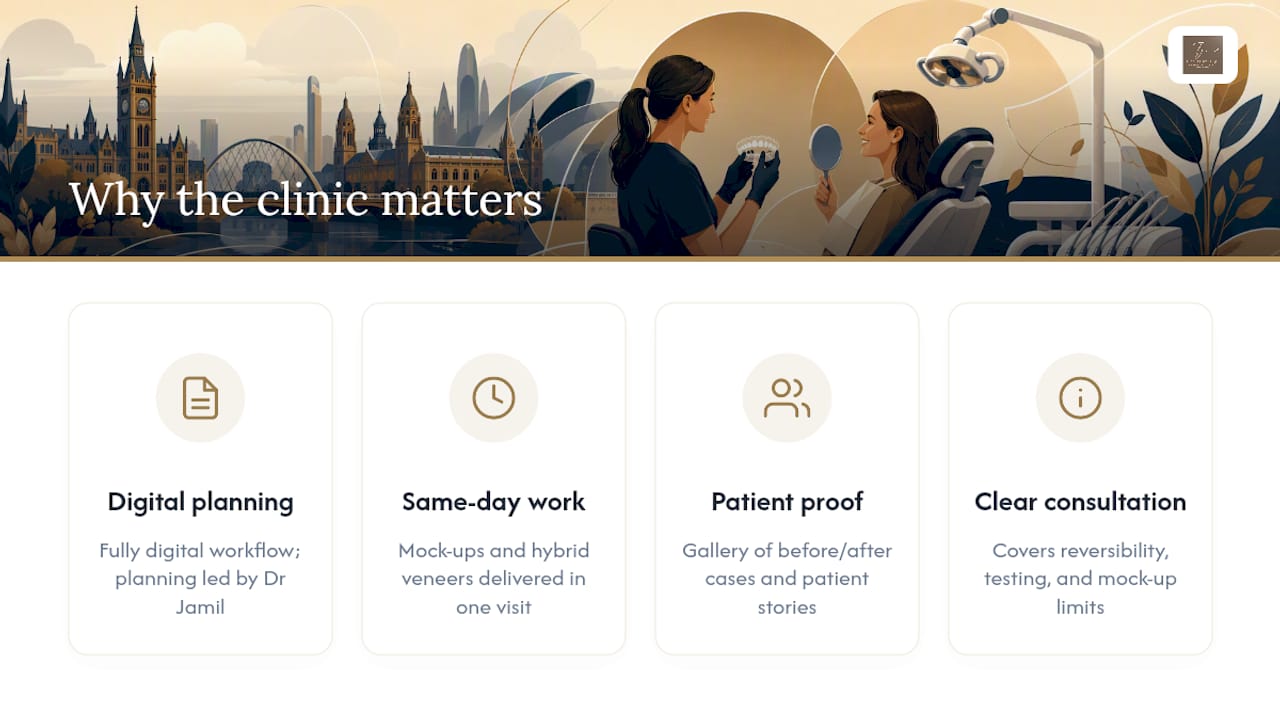
Fabrication method matters less than who is doing the planning. At TJ Smile Studio in Glasgow, Dr Tashfeen Jamil BDS, MFDS RCS Ed, AssocFCGDent, GDC 286427 oversees treatment planning using a fully digital workflow, meaning many mock-ups and even same-day hybrid veneers are designed and delivered within a single visit rather than across multiple lab-dependent appointments.
Patients considering a digital smile makeover can review a gallery of real before-and-after cases and read patient stories from people who went through the same trial-first process before committing to veneers or bonding. Every consultation includes a clear conversation about reversibility, functional testing, and exactly what the mock-up can and cannot tell you about the finished result.
What dentists learn from watching patients wear a mock-up
Every clinician who has fitted a trial smile has a version of the same story: a patient who was convinced they wanted teeth two shades whiter and noticeably longer, until they saw it in the mirror and heard themselves talk. Preferences shift the moment theory becomes something you can actually feel in your mouth.
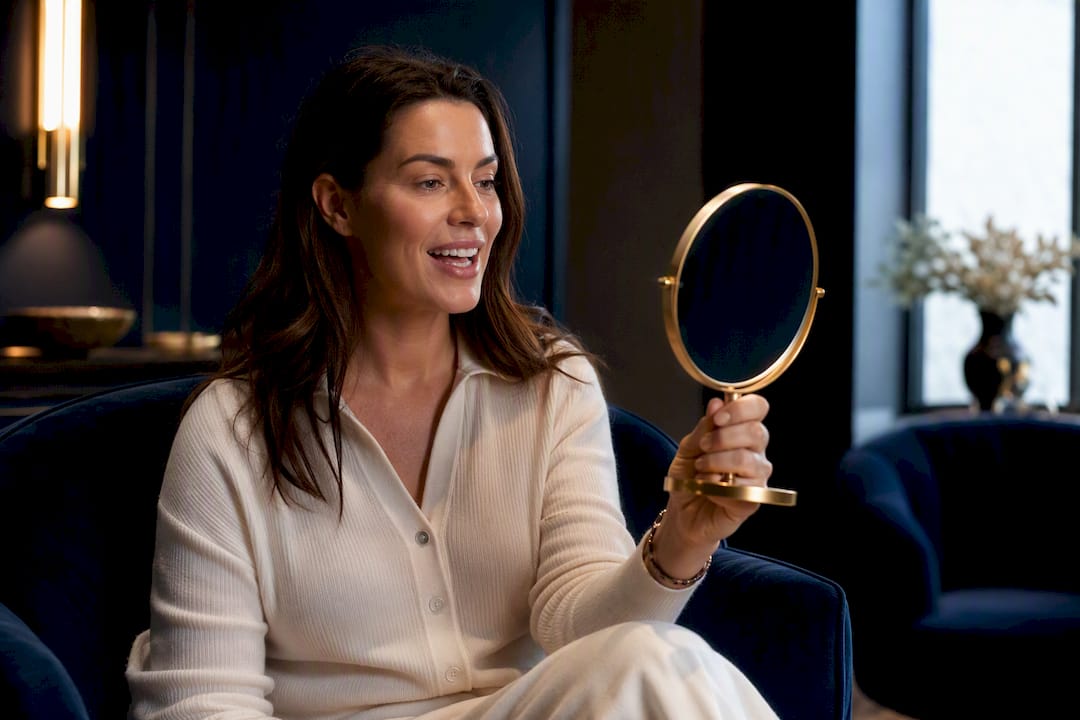
I have seen mock-ups catch problems that no consultation photo would have flagged, a lisp appearing on certain sounds, or lips sitting oddly over a shape that looked perfect on screen. Catching that before the lab cuts porcelain is the entire point. A trial smile is not a delay tactic. It is the single step that stops a patient from paying for veneers twice.
Anyone weighing up a significant smile change deserves that same chance to test it first, in person, before agreeing to anything permanent.
— Dr Tashfeen Jamil BDS, MFDS RCS Ed, AssocFCGDent - GDC 286427
Ready to trial your new smile in Glasgow?
TJ Smile Studio gives you a genuine try-before-you-commit route to a new smile, something a straight-to-porcelain provider simply cannot offer. Because the entire process runs on a digital workflow, your mock-up is designed, adjusted and often finalised within a single visit, so you are testing speech, bite and lip support the same day you walk in, not weeks later.
Whether you are exploring veneers, composite bonding, or a full digital smile makeover, the trial stage is built into the plan rather than charged as an afterthought. Larger treatment packages can be financed, and some appointments require a booking deposit, details Dr Jamil’s team will confirm before you commit to anything. Book a free smile assessment to see your own trial smile in the mirror before you decide on anything permanent.
Sources
- The art of the trial smile in cosmetic dentistry - Aesthetic Medicine
- The trial smile: how mock-ups ensure veneers look perfect - Dr Dani B
This article is general information, not a substitute for advice from a qualified doctor. Consult a qualified healthcare professional about your own circumstances before acting on anything here.
FAQ
What is the rarest smile type?
Dental aesthetics generally classify smiles by how much gum and tooth show when you smile fully, and the “low” smile line, where little to no gum tissue is visible, is considered the least common pattern among adults.
How much would 12 veneers cost in the UK?
Veneer pricing varies by clinic, material and case complexity, so ask for a written quote covering the full arch rather than a single-tooth rate before comparing providers.
Why do dentists advise against veneers?
Dentists pause veneer treatment where there is active gum disease, insufficient healthy enamel, uncontrolled bruxism, or an unresolved bite problem, because veneer preparation is irreversible and these conditions raise the risk of failure or sensitivity.
Is there a cheaper alternative to dental implants in the UK?
Yes. Bridges, partial dentures and full dentures generally cost less upfront than implants, though they differ in longevity and how well they preserve underlying jawbone over time.
Does TJ Smile Studio offer a trial smile before veneers?
Yes. TJ Smile Studio’s digital workflow allows patients to preview shape, length and bite feel in a mock-up before committing to permanent veneers or composite bonding.
Recommended
This article is general information, not personal dental advice. What’s right for your teeth depends on a clinical examination — the condition of your enamel, gums, bite and any existing dental work — and no article can assess that. Outcomes vary between patients, and all treatment at TJ Smile Studio is subject to assessment and clinical suitability.
- Dr Tashfeen Jamil BDS, MFDS RCS Ed, AssocFCGDent, PGDip Restorative and Aesthetic Dentistry — GDC registration 286427
This article is general information, not personal dental advice. What's right for your teeth depends on a clinical examination — the condition of your enamel, gums, bite and any existing dental work — and no article can assess that. Outcomes vary between patients, and all treatment at TJ Smile Studio is subject to assessment and clinical suitability.
Clinically reviewed by Dr Tashfeen Jamil BDS, MFDS RCS Ed, AssocFCGDent, PGDip Restorative and Aesthetic Dentistry — GDC registration 286427, Principal Dentist at TJ Smile Studio, 1 Spiersbridge Way, Thornliebank, Glasgow G46 8NG.
If you have dental pain, swelling or an injury, call the practice on 07728 808510. Out of hours in Scotland, call NHS 24 on 111.